

Establishing Your Robotic Automation CoE Governance Team
Composing your CoE governance team is a crucial part of your automation journey. Similar to any functioning management team, every member utilizes their expertise and skills to play a unique part in ensuring that the expected results are achieved. Business analysts, connectivity experts, automation developers, trainers, change management, and an excellent project manager to orchestrate all of these resources, across multiple automation projects, is your key to success.
The CoE team works with various department in your organization and serves as the single competency center that helps to uncover potential automation projects, and then works closely with the business owners in each department to design, deliver and maintain these projects. Automation is a living, dynamic service, and therefore the CoE team needs to keep in touch with each business domain where automation is delivered, to ensure that the right changes are made, and that value is realized in the long term.
Detailed descriptions of the various CoE roles, as well as the job responsibilities and required skills are detailed below.
The CoE Governance Team Structure
The governance roles as listed below describe the entire team, however, as one size does not fit all, the team size or structure may vary from one organization to another.
In a small or mid-size CoE, one person can act in more than one role.
A few common forms of CoE include:
-
Centralized: The entire team is located in the same organizational unit.
-
Semi Distributed: Central management of CoE with Automation Business Analysts located in the relevant business units, for example, Finance, HR, and Customer Service.
-
Distributed: Central management of CoE with Automation Business Analysts and Automation Developers located in the relevant business units.
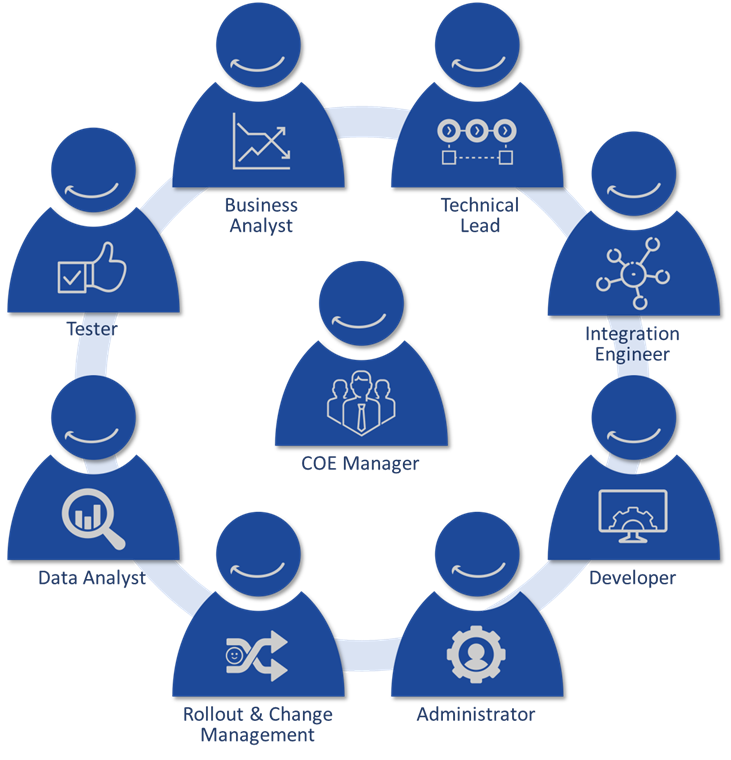
CoE Roles
Center of Excellence Manager
The CoE manager leads and co-ordinates all resources and activities related to the automation CoE.
Automation Business Analyst
The Automation Business Analyst is a subject matter expert who translates challenges into automation solutions by analyzing potential challenges. They are responsible for working with the business groups to prioritize potential use cases and create detailed design documents used by the development team.
Automation Technical Lead
The Automation Technical Lead is responsible for the quality of the developers output and the team development best practices, as well for defining the implementation layer (common or in local).
Automation Developer
The Automation Developer is the end-to-end solution creator who executes the various automation processes using the NICE APA Designer to create Robotic Automation projects.
Automation Integration Engineer
The Automation Integration Engineer manages and maintains the integration layer.
Automation Administrator
The Automation Administrator is responsible for the on-going automation solutions technical management and maintenance.
The Automation Administrator will act as the liaison between the CoE and the IT department in the organization.
Automation Rollout and Change Management Lead
The Automation Rollout and Change Management Lead is responsible for the education and enablement activities for the various business users using the automation solution.
In addition, the Automation Rollout and Change Management Professional steers and co-ordinates all change management activities, ensuring maximum adoption of the automation solutions.
Automation Data Analyst
The Automation Data Analyst defines and measures the automation value.
Automation Tester
The Automation Tester will run the end-to-end solution testing; will execute testing of the various processes of automation using the NICE Automation software in the Test environment.
The testing includes error handling and data validity.
